

Getting the best offer for a life insurance policy means comparing multiple quotes with identical coverage terms and exploring both traditional market options and life settlement alternatives. The difference between accepting the first quote you see and shopping strategically can translate to thousands of dollars saved or gained. Sources like NerdWallet, Liberty Mutual, and MoneyTalksNews consistently confirm that policyholders who compare at least three to four carriers secure significantly better outcomes. Whether you are buying a new policy or evaluating an existing one, the path to the best financial result runs through informed comparison, policy type awareness, and knowing when a life settlement outperforms a simple surrender.
How to get the best offer when comparing life insurance quotes
Comparing multiple quotes for identical coverage can save 30% to 50% on premiums, with price differences reaching as high as 73% in some cases. That is not a rounding error. That is the difference between a policy that fits your budget and one that quietly drains it for decades.
The only way to compare quotes fairly is to hold every variable constant. Same death benefit amount. Same term length. Same policy type. If you request a $500,000, 20-year term policy from Prudential and then ask Northwestern Mutual for a $500,000, 30-year whole life policy, you are not comparing offers. You are comparing apples to furniture.
Here is what a real price spread looks like in practice:
-
A healthy 35-year-old requesting $500,000 in term life coverage will see monthly premiums ranging from $22 to $55 depending on the carrier.
-
For $1 million in term life coverage, Nationwide averages around $41.89 per month, Pacific Life around $55.08, and State Farm around $60.94.
-
That gap compounds over a 20-year term into a difference of thousands of dollars in total premiums paid.
Insurers weigh risk factors differently, which is why the best price insurer can shift with even small changes to your profile. Age, health classification, smoking status, gender, and state of residence all affect where you land in each carrier’s pricing tier. A 45-year-old non-smoker in Texas may get the best rate from Ladder, while the same profile in New York gets a better deal from Bestow. This is why getting quotes from four or more carriers is not optional. It is the baseline.
Online-first carriers like Ladder and Bestow use algorithms and lower overhead to offer faster approvals and competitive premiums. Traditional carriers like Prudential and Northwestern Mutual may require full medical underwriting but often provide more flexible policy structures. The smartest approach combines both: use digital tools to get fast baseline quotes, then work with an independent agent to access carriers that do not publish rates publicly.
Pro Tip: Request quotes from at least one online-first carrier and at least two traditional carriers simultaneously. This gives you a price floor from the digital market and a coverage ceiling from full-underwriting carriers.
What types of life insurance policies affect your offer
Understanding policy types is not just academic. It directly determines what you pay, when your benefits activate, and whether the policy will actually pay out when your family needs it.
Term life insurance covers a fixed period, typically 10, 20, or 30 years, and carries the lowest premiums for the highest death benefit. It is the most cost-effective option for most working-age adults with dependents. Whole life and universal life policies build cash value over time but carry significantly higher premiums for the same death benefit amount.
Simplified issue and guaranteed issue policies serve applicants who cannot qualify for standard underwriting due to age or health conditions. The tradeoffs are real and worth understanding before you commit:
-
Guaranteed issue policies accept all applicants without a medical exam, but require a 2 to 3 year waiting period before full death benefits apply.
-
If death occurs during that waiting period, most carriers refund only the premiums paid, not the full face value.
-
Premiums for guaranteed issue policies are substantially higher than standard term coverage for the same benefit amount.
-
Simplified issue policies require answers to health questions but no physical exam, placing them between standard and guaranteed issue in both cost and accessibility.
Chasing the lowest monthly premium without reading the fine print is one of the most common and costly mistakes policyholders make. Liberty Mutual advises balancing cost with coverage quality and insurer reputation rather than selecting solely on price. A policy with graded benefits that pays only a fraction of the death benefit in year one is not the same product as a fully underwritten policy, regardless of what the premium comparison looks like on a spreadsheet.
Your health status and age are the two most powerful levers in determining your offer. Buying earlier locks in lower rates permanently. Improving measurable health markers like blood pressure, cholesterol, or BMI before applying can move you into a better underwriting class and reduce premiums by 15% to 25% depending on the carrier.
How life settlements can provide a better financial offer for existing policies
A life settlement is the sale of an existing life insurance policy to a third-party buyer for a lump sum that exceeds the policy’s cash surrender value. This is the industry-standard term for what many policyholders do not realize is an option when a policy no longer fits their financial situation.

The difference between a life settlement and surrendering a policy to the insurance company is significant. When you surrender a policy, you receive the cash surrender value, which is often a fraction of what the policy is worth on the open market. A life settlement puts that policy into a competitive bidding process where institutional buyers evaluate it based on your life expectancy, the premium obligations remaining, and the death benefit amount.
Settlement payouts typically range from 10% to 30% of the death benefit, and sometimes considerably higher depending on the policyholder’s age and health profile. Asset Life Settlements secured a full $2 million settlement for an 85-year-old client in a challenging market environment, which illustrates how broker expertise and competitive bidding can produce results well above baseline expectations.
Here is a simplified comparison of what different exit strategies typically yield:
| Exit Strategy | Typical Payout | Best For |
|---|---|---|
| Policy surrender | Cash surrender value only | Policies with minimal market value |
| Lapse (stop paying) | $0 | No one |
| Life settlement | 10%–30%+ of death benefit | Policies $100,000+ face value |
| Retained policy | Full death benefit at claim | Ongoing coverage need |
The fair market value of a policy buyout is calculated using two IRS-recognized valuation methods involving premium history, earnings, and reserves. This complexity is why offers from different buyers vary and why working with a licensed broker who creates competitive bidding among multiple buyers produces materially better outcomes than approaching a single buyer directly.
Life settlement calculators, including the one available through Asset Life Settlements, provide a useful starting estimate. They factor in age, health status, policy type, and face value to generate a preliminary range. Treat calculator outputs as directional, not definitive. The actual offer depends on full medical underwriting by the settlement buyer.
Pro Tip: Policies with a face value of $100,000 or more, held by policyholders aged 65 and older, are the strongest candidates for life settlement. Check your settlement eligibility before assuming surrender is your only option.
Step-by-step process to maximize your policy’s value
Getting the best financial outcome from a life insurance policy, whether new or existing, follows a clear sequence. Skipping steps costs money.
-
Gather your complete profile before shopping. Age, health history, current medications, smoking status, and desired coverage amount all affect quotes. Incomplete information produces inaccurate quotes that change at underwriting.
-
Request quotes from at least four carriers using identical coverage criteria. Use online tools for digital carriers and an independent agent for traditional carriers. Never compare quotes with different term lengths or benefit amounts.
-
Read the underwriting type and policy fine print. Confirm whether the policy uses full medical underwriting, simplified issue, or guaranteed issue. Note any waiting periods, graded benefit schedules, or exclusions.
-
Consider health improvements before finalizing. If your application is not time-sensitive, improving measurable health metrics can shift your underwriting class and reduce premiums meaningfully.
-
Evaluate life settlement options if the policy already exists. If you are paying premiums on a policy that no longer serves your needs, compare the surrender value against a competitive settlement offer before making any decision.
Common mistakes that reduce your offer or increase your cost:
-
Accepting the first quote without comparison, which statistically means overpaying.
-
Ignoring policy clauses around graded benefits or contestability periods.
-
Assuming surrender value is the maximum you can receive for an existing policy.
-
Waiting too long to buy, since every year of age increases term life premiums.
Timing matters in both directions. Buying term life coverage earlier in life locks in lower rates for the full term. For existing policies, re-shopping after a significant health improvement can qualify you for better rates through a new policy, while a health decline may actually increase the life settlement value of an existing policy by shortening life expectancy in the buyer’s calculation.
Key takeaways
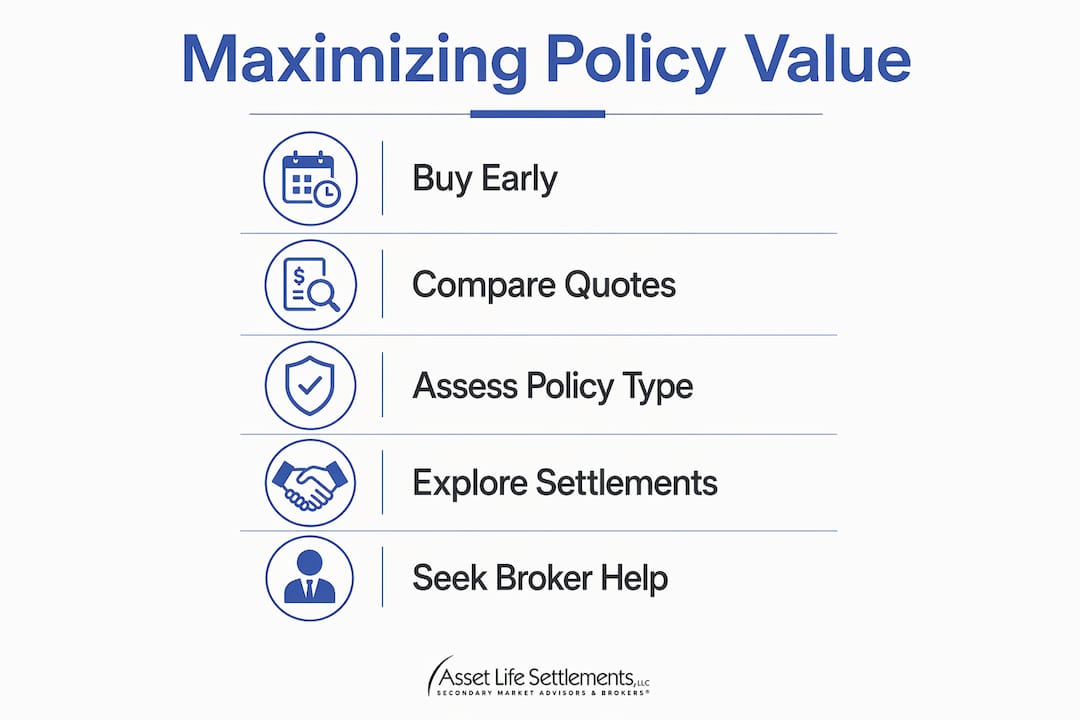
The best financial outcome from a life insurance policy comes from comparing at least four carriers with identical coverage terms and evaluating life settlement alternatives before surrendering any existing policy.
| Point | Details |
|---|---|
| Compare with identical criteria | Request quotes for the same benefit, term, and policy type across four or more carriers. |
| Price gaps are substantial | Premiums for identical coverage can vary by up to 73% across carriers for the same applicant. |
| Policy type changes the offer | Guaranteed issue policies carry waiting periods and graded benefits that affect real payout value. |
| Life settlements beat surrender | Settlement payouts typically exceed cash surrender value, often reaching 10%–30% of the death benefit. |
| Broker competition drives value | Working with a licensed broker who creates bidding competition produces higher settlement offers. |
Why most policyholders leave money on the table
Most people treat life insurance as a set-it-and-forget-it decision. They buy a policy, pay the premiums, and never revisit whether the policy still fits their financial picture or whether a better offer exists. That passivity is expensive.
I have seen policyholders surrender $500,000 policies for $8,000 in cash surrender value because no one told them the life settlement market existed. I have also seen people pay 40% more in premiums than necessary for 20 years because they accepted the first quote they received. Both situations are avoidable with the same solution: comparison and advocacy.
The conventional wisdom says to buy the cheapest policy you can find. That advice is incomplete. The cheapest policy with a two-year waiting period is not equivalent to a fully underwritten policy at a slightly higher premium. The difference shows up when a claim is filed, not when the application is signed.
Life settlements are the most underappreciated tool in the policyholder’s financial toolkit. Seniors, individuals whose health has changed, and anyone whose financial obligations have shifted since buying a policy should evaluate settlement value before making any lapse or surrender decision. The life settlement process is more accessible than most people realize, and the financial difference between a settlement and a surrender can be substantial.
My consistent recommendation: shop with at least four carriers, read every clause before signing, and never surrender an existing policy without first getting a settlement valuation from a licensed broker.
— Jeff Hallman
How Asset Life Settlements helps you get the best offer

Asset Life Settlements is a licensed broker that connects policyholders to a competitive marketplace of institutional buyers, creating the bidding competition that drives settlement offers higher. The team manages every step of the process, from policy documentation and medical records to negotiation and final settlement, so you are never navigating the market alone.
If you hold a life insurance policy with a face value of $100,000 or more and are 65 or older, your policy may be worth significantly more than its surrender value. Asset Life Settlements has a proven track record of securing maximum value even in difficult market conditions. Visit Asset Life Settlements to request a policy valuation and find out what your policy is actually worth on the open market.
FAQ
What does it mean to get the best offer for a life insurance policy?
Getting the best offer means comparing quotes from at least four carriers using identical coverage terms and evaluating life settlement options for existing policies. The goal is maximum financial value, whether through lower premiums on a new policy or a higher payout from selling an existing one.
How much can I save by comparing life insurance quotes?
Comparing quotes for identical coverage can reduce premiums by 30% to 50%, with price differences reaching up to 73% between carriers for the same applicant profile.
What is a life settlement and how does it differ from surrendering a policy?
A life settlement is the sale of an existing policy to a third-party buyer for a lump sum that exceeds the cash surrender value. Settlement payouts typically range from 10% to 30% of the death benefit, while surrender returns only the accumulated cash value, which is often far less.
Who qualifies for a life settlement?
Policyholders aged 65 and older with policies carrying a face value of $100,000 or more are the strongest candidates. Health changes that affect life expectancy can also increase settlement value, making eligibility worth checking even for younger policyholders with serious health conditions.
Should I use a broker to get a life settlement offer?
Working with a licensed broker creates competitive bidding among multiple institutional buyers, which produces higher offers than approaching a single buyer directly. Asset Life Settlements specializes in this process and manages documentation, medical records, and negotiation on your behalf.